

At a glance
The Tokyo Metropolitan Government Building offers free observation decks in its twin towers, providing panoramic city views from 202 meters high. Designed by architect Kenzo Tange, this landmark government building features public viewing areas, a gift shop, and opportunities to spot Mount Fuji on clear days.
Photographs
Tokyo Metropolitan Government Building
Rising from the heart of Shinjuku, the Tokyo Metropolitan Government Building—designed by the celebrated architect Kenzo Tange—is a bold example of postmodern architecture that fuses futuristic form with subtle nods to traditional Japanese motifs. Its twin towers, structured with a cathedral-like verticality, house two public observation decks on the 45th floor, each offering sweeping 360-degree panoramas of Tokyo's urban sprawl.
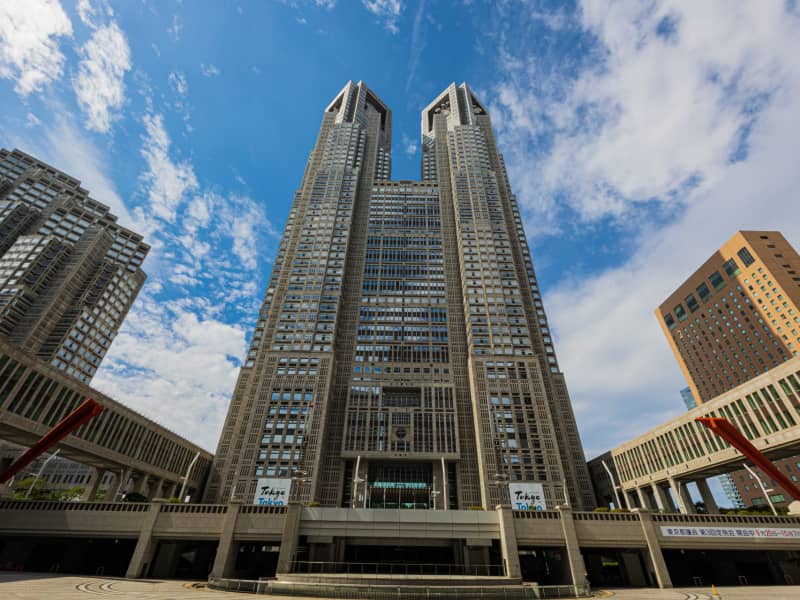

The North Observatory and South Observatory, both perched 202 meters above ground, are among Tokyo’s best free viewpoints. On clear days, especially during winter, the South deck is prized for its direct line of sight to Mount Fuji, while the North deck frames iconic landmarks like Tokyo Skytree, Tokyo Tower, and even the shimmering Yokohama skyline. Although standard tripods are not permitted inside the decks, visitors often bring compact table tripods or flexible GorillaPods to stabilize their cameras discreetly on the window ledges.


At night, the building transforms into a luminous monolith. Its facade lighting changes regularly, often themed to commemorate national holidays, international causes, or local events. One of the most striking ways to experience this is from the public courtyard below, which remains open even after the building closes. This area becomes peacefully deserted at night, offering a serene, uncrowded setting for night photography or quiet reflection amid the towering shadows.


Inside, the building also hosts a Tokyo Tourist Information Center, along with souvenir shops and cafés where visitors can unwind. The South Observatory occasionally features live piano performances, further enriching the atmosphere. Meanwhile, the North Observatory tends to be the quieter of the two, often favored by photographers for its steady lighting and wide-angle vantage.
With its architectural grandeur, panoramic views, and dynamic nightly illuminations, the Tokyo Metropolitan Government Building remains a must-visit destination for travelers seeking both city-scale perspective and creative photography opportunities in Tokyo.
Before you go
Entry to both observation decks is free. Note that tripods and monopods are prohibited inside the observatories, so bring a small table tripod or GorillaPod if you plan to take stable photos. Elevators to the observation floors operate on a ticketed, timed-entry system during busy seasons, so expect short waits. The courtyard area outside remains open even after the building closes, allowing night photographers to capture the light-up displays without restriction.
South Observatory (南展望室)
- Open Hours: 9:30 AM – 9:30 PM
- Closed: 1st and 3rd Tuesdays of each month (If the day falls on a public holiday, it closes the following weekday)
North Observatory (北展望室)
- Open Hours: 9:30 AM – 5:00 PM
- Closed: 2nd and 4th Mondays of each month (If the day falls on a public holiday, it closes the following weekday)
Note:
- When the South Observatory is closed, the North Observatory stays open until 9:30 PM to accommodate evening visitors.
- Both decks may close during year-end holidays or for maintenance—check the official website before visiting.
- Open daily during scheduled hours; occasional closures or changes for maintenance may apply.
When to go
Spring and autumn offer exceptional clarity for spotting Mount Fuji from the observation decks, especially on crisp mornings. Winter visits provide stunning views of snow-capped peaks, while summer evenings showcase spectacular city lights against the warm sky. Early mornings, just after opening at 8:30 AM, provide the best opportunity for clear views and minimal waiting times. For evening visits, arriving before sunset allows you to experience both daytime panoramas and the transition to Tokyo's glittering nightscape. The courtyard is best visited after 8 PM, when office crowds have cleared and the building is dramatically lit. Avoid weekends and national holidays if you prefer a more relaxed atmosphere.
Public review summary
Visitors consistently praise the free observation deck access while noting the outstanding city views. The North deck receives particular acclaim for Mt. Fuji visibility on clear days. Staff friendliness and efficient queuing systems are frequently highlighted. Some mention waiting times of 20-40 minutes during peak hours, particularly around sunset. The on-site café and souvenir shop receive mixed feedback, with ice cream offerings being a popular choice. Evening projection mapping shows earn special praise.
What you'll find here
Location & access
- DirectionsAddress
2 Chome-8-1 Nishishinjuku, Shinjuku City, Tokyo 163-8001, Japan
- How to get there
By Public Transport: Approximately 10 minutes on foot from Shinjuku Station.
Common questions
Can I see Mount Fuji from the Tokyo Metropolitan Government Building?
Yes, on clear days you can see Mount Fuji from the North Observatory deck. The North Tower generally offers better views of Mount Fuji than the South Tower, making it the preferred choice for visitors hoping to catch a glimpse of Japan's iconic mountain.
Is there an admission fee for the observation decks?
The observation decks at the Tokyo Metropolitan Government Building are completely free to visit. This makes it one of Tokyo's most accessible high-rise viewing points, offering panoramic city views without any entrance charges.
Which observation deck is better - North or South Tower?
The North Tower is generally recommended as it offers views of Mount Fuji and tends to have better overall visibility. The North deck also receives consistent praise from visitors for its viewing angles of the city skyline.
What facilities are available at the observation deck level?
The observation decks feature gift shops and cafes where visitors can relax while enjoying the views. The facilities are wheelchair accessible, and there's a tourism promotion corner on the first floor showcasing all 47 Japanese prefectures.
How long are the typical wait times for the elevators?
Wait times typically range from 20-35 minutes during peak periods, though they can be shorter during off-peak hours. Morning visits usually have the shortest queues, with waiting times of less than 20 minutes.

Bring this spot to life with a local photographer
Book a vetted local photographer who knows the best light, angles, and timing for this location.