Scenic ViewpointsUrban HighlightsNature/Parks

Where to See Ginkgo Trees in Tokyo: Best Golden Avenues

Golden streets and tree-lined walks across the capital

LLensTokyoPublished Aug 13, 2026
Kanto, Tokyo
Where to See Ginkgo Trees in Tokyo: Best Golden Avenues
Kanto, Tokyo
Before you go📍

Overview

Each autumn, Tokyo’s ginkgo trees turn from deep green to brilliant yellow, bringing a distinctive golden color to streets, parks, university campuses, and shrine approaches across the city. Usually reaching their best color from mid-November to early December, these trees often peak slightly later than many of Tokyo’s other autumn leaves.


Some of the capital’s best-known displays form carefully aligned avenues, while others appear along quieter neighborhood streets and spacious park paths. From the famous trees of Meiji Jingu Gaien to the residential surroundings of Seijo and the historic Hongo Campus, these locations show different sides of Tokyo’s ginkgo season, with settings ranging from monumental architecture to everyday city landscapes.

The guide🗼

The full guide

Spot 01/ 10
Koshu Kaido Ginkgo Avenue
Kanto, Tokyo
Free Entry

Koshu Kaido Ginkgo Avenue

甲州街道 イチョウ並木

A four-kilometer corridor glowing gold each autumn

Koshu Kaido Ginkgo Avenue in Hachioji offers one of Tokyo’s longest stretches of ginkgo-lined urban scenery, extending for several kilometers along the historic Koshu Kaido road. Hundreds of mature ginkgo trees line both sides of the avenue, creating an impressive sequence of golden streets through western Tokyo. The trees were originally planted in 1929 in connection with the construction of the Tama Imperial Mausoleum, giving the avenue a historical character beyond its seasonal appeal.


The scenery is particularly striking in mid to late November, when the foliage turns yellow and fallen leaves begin covering sections of the roadside. Unlike a single pedestrian promenade, the ginkgo trees follow an active roadway, allowing visitors to explore different sections around Hachioji and Takao. Pedestrian overpasses at several points provide elevated perspectives over the rows of trees, while the sidewalks offer closer views beneath the autumn canopy. There is no admission fee, making it easy to include in an autumn visit to western Tokyo.

Lens Score7.1/10Worth Visiting

Combines visitor ratings, review volume, photo evidence, and expert assessment across 8 categories for Koshu Kaido Ginkgo Avenue.

Experiential52%
Nature/Outdoor68%
Heritage Value58%
Photogenic60%
Learning54%
Budget Friendly75%
Design/Arch.56%
Crowd Free50%
Spot 02/ 10
Meiji Jingu Gaien Gingko Avenue
Kanto, Tokyo
Free Entry

Meiji Jingu Gaien Gingko Avenue

明治神宮外苑 いちょう並木

Symmetry and sunlight under golden ginkgo trees

Meiji Jingu Gaien Ginkgo Avenue is one of Tokyo’s most celebrated ginkgo-lined streets, known for its striking symmetry and distinctive rows of carefully shaped trees. The avenue leads toward the Meiji Memorial Picture Gallery, creating a long perspective framed by historic architecture and the surrounding sports district. While the trees provide a lush green canopy through the warmer months, the avenue is at its most distinctive in autumn, typically from mid-November to early December, when the leaves turn vivid shades of yellow and gold.


During peak foliage, the combination of golden branches overhead and fallen leaves along the pavement creates a particularly photogenic setting. It is also one of Tokyo’s most popular seasonal viewing areas, so early morning is recommended for photography and a quieter walk. Its central location and easy access from Aoyama make the avenue a convenient place to experience Tokyo’s ginkgo season without leaving the city center.

Lens Score7.7/10Worth Visiting

Combines visitor ratings, review volume, photo evidence, and expert assessment across 8 categories for Meiji Jingu Gaien Gingko Avenue.

Experiential60%
Nature/Outdoor66%
Heritage Value60%
Photogenic76%
Learning50%
Budget Friendly60%
Design/Arch.50%
Crowd Free18%
Spot 03/ 10
University of Tokyo Ginkgo Avenue
Kanto, Tokyo
Free Entry

University of Tokyo Ginkgo Avenue

東京大学本郷キャンパス 銀杏並木

Golden autumn corridor framed by historic university architecture

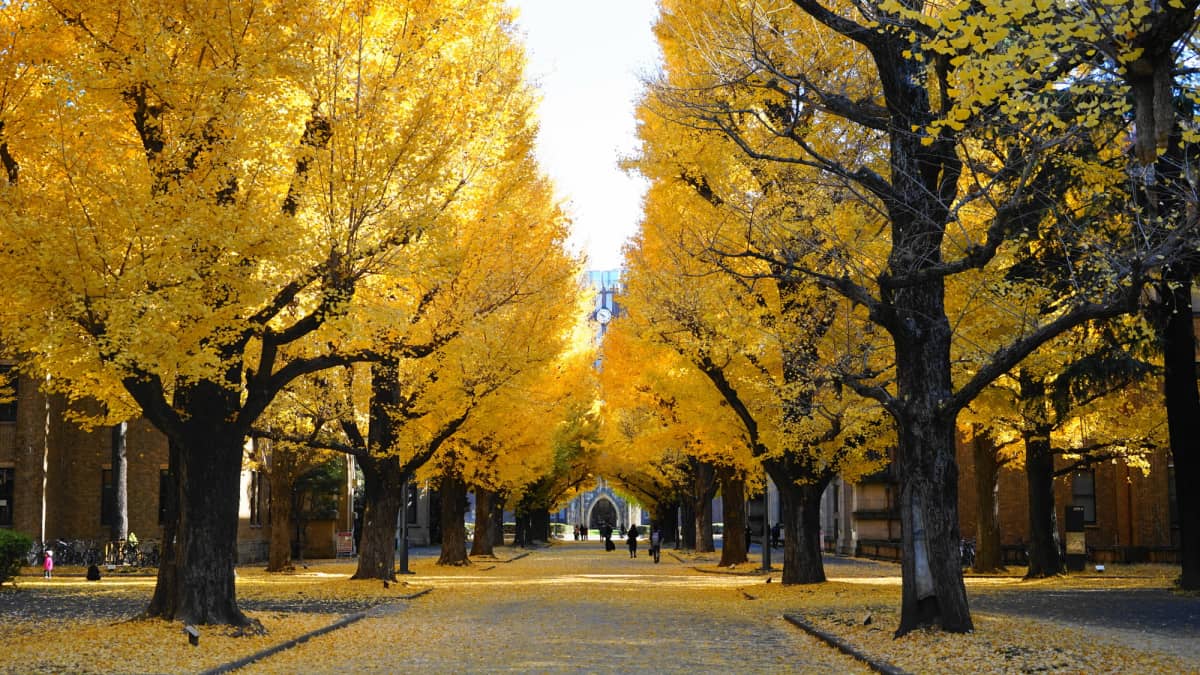
The University of Tokyo’s Hongo Campus is home to one of Tokyo’s most atmospheric ginkgo avenues, where rows of mature trees extend from the Main Gate toward the distinctive Yasuda Auditorium. In late autumn, the leaves turn brilliant yellow, creating a golden canopy above the campus paths while fallen foliage carpets the ground. The combination of ginkgo trees, red-brick academic buildings, and historic campus architecture gives this location a character quite different from Tokyo’s parks and public boulevards.


Ginkgo has a particularly strong connection with the university, appearing as a longstanding symbol associated with the campus. Visitors can also find a large historic ginkgo tree near the Faculty of Engineering area, alongside several other pockets of autumn color around Hongo. The foliage is generally most attractive from late November into early December. The campus is an active educational environment, so visitors should explore quietly, respect restricted areas, and avoid disrupting students and university activities while taking photographs.

Lens Score7.9/10Worth Visiting

Combines visitor ratings, review volume, photo evidence, and expert assessment across 8 categories for University of Tokyo Ginkgo Avenue.

Experiential55%
Nature/Outdoor68%
Heritage Value70%
Photogenic72%
Learning58%
Budget Friendly75%
Design/Arch.70%
Crowd Free46%
Spot 04/ 10
Showa Kinen Park
Kanto, Tokyo
Free Entry

Showa Kinen Park

国営昭和記念公園

Golden trees and endless cycling paths

Showa Kinen Park is one of Tokyo’s most impressive places for autumn ginkgo scenery, with spacious grounds in Tachikawa offering a very different experience from the city’s urban avenues. Its best-known autumn feature is the Ginkgo Avenue near the Tachikawa entrance, where two rows of neatly shaped trees form a symmetrical golden corridor. Another ginkgo-lined area around the park’s canal provides additional autumn views, while fallen leaves gradually create a bright yellow carpet beneath the trees.


The ginkgo season generally reaches its best color in November, alongside other autumn foliage across the park. With broad walking paths, cycling routes, open lawns, seasonal gardens, and a traditional Japanese garden, visitors can easily combine ginkgo viewing with a longer day outdoors. The park’s scale also provides plenty of opportunities for photography, although the most famous ginkgo avenues can become busy during peak autumn weekends.

Lens Score7.9/10Worth Visiting

Combines visitor ratings, review volume, photo evidence, and expert assessment across 8 categories for Showa Kinen Park.

Experiential64%
Nature/Outdoor75%
Heritage Value62%
Photogenic60%
Learning60%
Budget Friendly68%
Design/Arch.62%
Crowd Free58%
Spot 05/ 10
Gyoko-dori Avenue
Kanto, Tokyo
Free Entry

Gyoko-dori Avenue

行幸通り

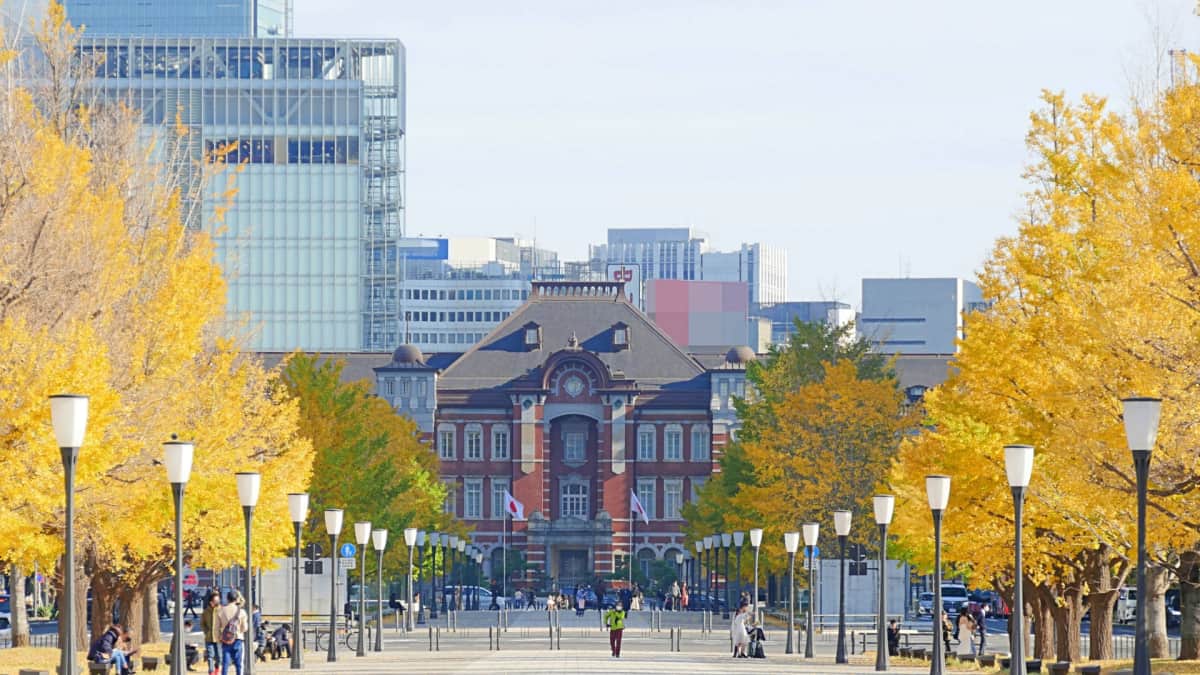
Golden ginkgo trees framing historic Tokyo Station

Gyoko-dori Avenue provides a distinctive ginkgo-lined perspective in the heart of central Tokyo, extending from the Marunouchi side of Tokyo Station toward the Imperial Palace. Its broad central promenade is framed by rows of ginkgo trees, while the restored red-brick Tokyo Station building creates an elegant architectural backdrop. In autumn, the foliage turns yellow and adds warm seasonal color to one of the capital’s most formal urban landscapes.


Unlike Tokyo’s denser tree tunnels, Gyoko-dori combines golden ginkgo foliage with historic and modern architecture, making it particularly appealing for street and cityscape photography. Visitors can photograph the trees with Tokyo Station in one direction and the Marunouchi skyline in the other, with especially atmospheric views around sunset and after the station is illuminated. The avenue is centrally located, free to visit, and easy to combine with Marunouchi, the Imperial Palace area, or an evening walk around Tokyo Station.

Lens Score7.5/10Worth Visiting

Combines visitor ratings, review volume, photo evidence, and expert assessment across 8 categories for Gyoko-dori Avenue.

Experiential56%
Nature/Outdoor68%
Heritage Value62%
Photogenic62%
Learning52%
Budget Friendly75%
Design/Arch.60%
Crowd Free55%
Spot 06/ 10
Yasukuni Shrine
Kanto, Tokyo
Free Entry

Yasukuni Shrine

靖國神社

Sacred grounds shaped by history, memory, and tradition

Yasukuni Shrine offers a broad ginkgo-lined approach in central Tokyo, where mature trees add vivid seasonal color to the shrine’s spacious grounds. During autumn, the ginkgo foliage along the main approach turns brilliant yellow, creating a striking contrast with the large torii gates, stone lanterns, and traditional shrine architecture. The long, open approach gives the autumn scenery a more monumental character than Tokyo’s narrower residential ginkgo streets.


The shrine is primarily a religious and historically significant site, commemorating those who died in service to Japan since the mid-19th century, and visitors should approach it with awareness of its complex and controversial modern history. For travelers focusing on seasonal scenery, the ginkgo trees are generally most attractive from late November into early December. The grounds are free to enter and can also be combined with nearby autumn locations such as the Imperial Palace area and Kitanomaru Park.

Lens Score8.1/10Highly Recommended

Combines visitor ratings, review volume, photo evidence, and expert assessment across 8 categories for Yasukuni Shrine.

Experiential60%
Nature/Outdoor68%
Heritage Value72%
Photogenic58%
Learning66%
Budget Friendly75%
Design/Arch.68%
Crowd Free46%
Spot 07/ 10
Komazawa Olympic Park
Kanto, Tokyo
Free Entry

Komazawa Olympic Park

駒沢オリンピック公園

A spacious green escape built around sporting history

Komazawa Olympic Park combines autumn ginkgo scenery with the architectural legacy of the 1964 Tokyo Olympics, offering a spacious seasonal setting in Setagaya. Mature ginkgo trees line several of the park’s broad paths and roads, turning vivid yellow as autumn reaches its peak. The golden foliage works particularly well with the park’s distinctive Olympic-era structures, including the Memorial Tower, creating a setting that feels quite different from Tokyo’s traditional gardens and residential avenues.


The park’s extensive grounds make it well suited to a relaxed autumn walk or photography session, with plenty of space to explore beyond the main tree-lined sections. Visitors can also use the cycling and jogging courses or stop at the open plazas and recreational areas while viewing the foliage. Ginkgo colors are generally at their best from late November into early December. Entry to the park itself is free, and its quieter neighborhood setting makes it a useful alternative to central Tokyo’s busiest autumn spots.

Lens Score7.8/10Worth Visiting

Combines visitor ratings, review volume, photo evidence, and expert assessment across 8 categories for Komazawa Olympic Park.

Experiential54%
Nature/Outdoor70%
Heritage Value68%
Photogenic62%
Learning58%
Budget Friendly75%
Design/Arch.68%
Crowd Free58%
Spot 08/ 10
Hikarigaoka Park
Kanto, Tokyo
Free Entry

Hikarigaoka Park

光が丘公園

Wide lawns, old trees, and easygoing neighborhood atmosphere

Hikarigaoka Park offers one of northern Tokyo’s most impressive ginkgo-lined walks, with mature trees adding vivid autumn color to the spacious park and surrounding Hikarigaoka district. The broad paths and open layout create long perspectives beneath the yellow foliage, while fallen leaves gradually form a golden carpet underfoot. Compared with the highly visited ginkgo avenues in central Tokyo, the setting has a more relaxed, neighborhood atmosphere that makes it particularly pleasant for an autumn stroll.


The park itself provides plenty to explore alongside the seasonal scenery, including large lawns, sports facilities, playgrounds, and wooded areas, making it suitable for visitors who want to spend more time outdoors rather than simply stop for photographs. Ginkgo foliage is generally most attractive from mid to late November, with other deciduous trees adding further autumn color across the grounds. Entry is free, and the spacious paths provide good opportunities for casual photography, walking, and enjoying Tokyo’s autumn landscape at a slower pace.

Lens Score7.8/10Worth Visiting

Combines visitor ratings, review volume, photo evidence, and expert assessment across 8 categories for Hikarigaoka Park.

Experiential56%
Nature/Outdoor70%
Heritage Value58%
Photogenic62%
Learning56%
Budget Friendly75%
Design/Arch.60%
Crowd Free55%
Spot 09/ 10
Seijo Gakuen-mae Ginkgo Avenue
Kanto, Tokyo
Free Entry

Seijo Gakuen-mae Ginkgo Avenue

成城学園前のいちょう並木

Golden autumn foliage along a quiet residential street

Seijo Gakuen-mae Ginkgo Avenue offers a quieter view of Tokyo’s autumn ginkgo scenery in the refined residential neighborhood of Seijo, Setagaya. Tall ginkgo trees line the street near the main gate of Seijo Gakuen, forming a compact tree-lined corridor that turns vivid yellow from late November to early December. Because the road is relatively narrow, the trees on either side feel particularly close, creating the impression of being surrounded by a golden canopy when the foliage reaches its peak.


The avenue is recognized as Setagaya 100 Scenic Views (Setagaya Hyakkei) No. 51, reflecting its place in the local streetscape. Although the main ginkgo-lined section is relatively short, additional large ginkgo trees can be seen along the same street, complementing the well-kept residential surroundings. The avenue is free to visit and about a six-minute walk from Seijo-gakuen-mae Station, making it a pleasant choice for travelers looking for a less crowded, neighborhood-scale autumn scene.

Lens Score5.5/10Plan Carefully

Combines visitor ratings, review volume, photo evidence, and expert assessment across 8 categories for Seijo Gakuen-mae Ginkgo Avenue.

Experiential52%
Nature/Outdoor62%
Heritage Value52%
Photogenic60%
Learning50%
Budget Friendly75%
Design/Arch.52%
Crowd Free55%
Spot 10/ 10
Yoyogi Park
Kanto, Tokyo
Free Entry

Yoyogi Park

代々木公園

Tokyo’s green stage for gatherings and play

Yoyogi Park, located in Tokyo's vibrant Shibuya district, is a sprawling green oasis featuring mature trees, serene lakes, and fountains. This free public park offers extensive walking paths, picnic areas, and seasonal flower displays, making it perfect for nature lovers and urban escapists.Yoyogi Park offers a spacious and informal setting for ginkgo viewing in central Tokyo, with mature trees scattered among its broad lawns, wooded areas, and walking paths. In autumn, sections of the park take on vivid shades of yellow as the ginkgo leaves change color, complementing the reds and oranges of other deciduous trees. Rather than a single tightly framed avenue, the park provides a more natural, open environment where visitors can enjoy Tokyo’s seasonal colors while exploring at their own pace.


Its location beside Harajuku and Meiji Jingu makes Yoyogi Park particularly convenient for adding autumn foliage to a day of sightseeing in Shibuya and Harajuku. The large lawns also make it suitable for picnics and relaxed walks, while the combination of trees and open spaces provides varied photography opportunities. Ginkgo foliage is generally most attractive from late November into early December. Entry is free, making the park an easy and accessible stop during Tokyo’s autumn season.

Lens Score7.7/10Worth Visiting

Combines visitor ratings, review volume, photo evidence, and expert assessment across 8 categories for Yoyogi Park.

Experiential48%
Nature/Outdoor75%
Heritage Value75%
Photogenic68%
Learning40%
Budget Friendly75%
Design/Arch.60%
Crowd Free50%
Wrapping up🎒

Final thoughts

Tokyo’s ginkgo avenues offer a different way to experience autumn from the maple-filled gardens and mountain landscapes often associated with the season. Their vivid yellow leaves transform familiar urban spaces, creating golden corridors, tree-lined approaches, and carpets of fallen foliage across the city.


Because peak color varies slightly by location and weather conditions each year, visiting several spots from mid-November onward can reveal different stages of the season. Whether photographed against historic architecture or enjoyed during a quiet neighborhood walk, Tokyo’s ginkgo trees provide a memorable reason to explore the capital as autumn transitions toward early winter.

Common questions💬

Frequently asked questions

When is the best time to see ginkgo trees in Tokyo?

The best period is generally mid-November to early December, although peak color varies by location and weather each year. Some areas in western Tokyo may change slightly earlier than central locations.

Where is the most famous ginkgo avenue in Tokyo?

Meiji Jingu Gaien Ginkgo Avenue is Tokyo’s best-known ginkgo-lined street. Its symmetrical rows of trees create a distinctive golden corridor during peak autumn foliage.

Where can I see ginkgo trees without the biggest crowds?

Locations such as Seijo Gakuen-mae Ginkgo Avenue, Hikarigaoka Park, and Komazawa Olympic Park generally offer a more relaxed atmosphere than Meiji Jingu Gaien, particularly on weekday mornings.

Are Tokyo’s ginkgo avenues free to visit?

Most locations in this guide are free to visit, including public streets, parks, shrine grounds, and accessible areas of the University of Tokyo campus. Showa Kinen Park requires an admission fee.

Are ginkgo trees the same as autumn maple trees?

No. Ginkgo leaves turn predominantly bright yellow and gold, while Japanese maples are known for red, orange, and sometimes yellow foliage. Tokyo’s ginkgo trees also tend to reach peak color relatively late in the autumn season.

Shoot it properly

Want a photographer who knows every angle?

Book a local photographer who already knows which spots are quiet at which hour — and skip the guesswork.

Never miss what's next ✉️

Be the first to know
what we're framing next

By submitting your email, you'll be the first to know about upcoming updates for LensTokyo. You can unsubscribe at any time.